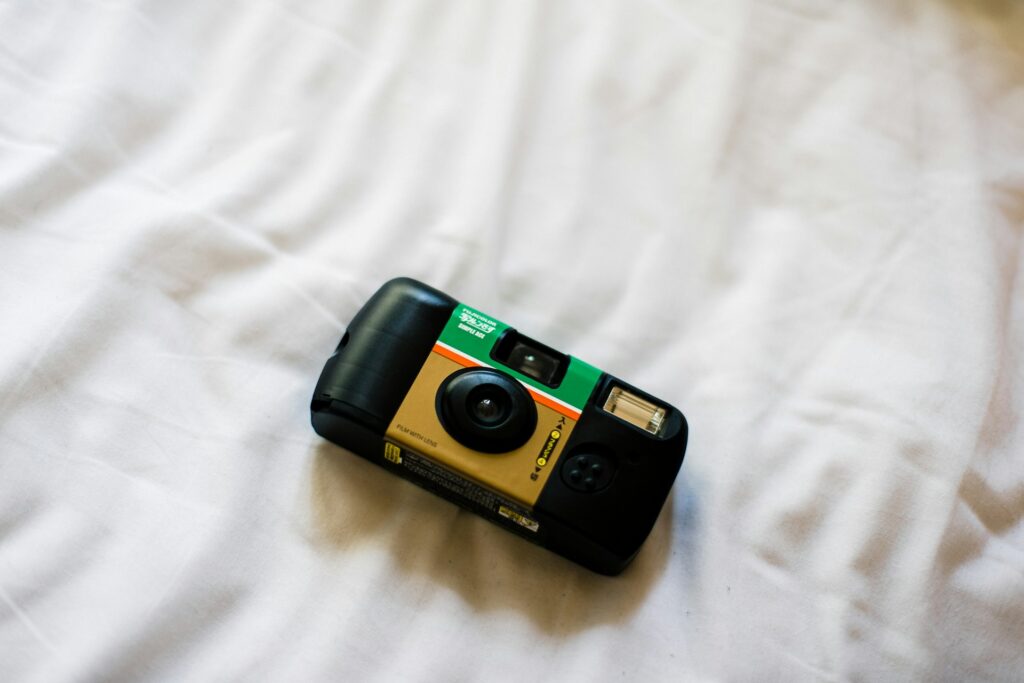
The short version: Disposable cameras at weddings cost $150–$300 for a 50-guest wedding and typically produce 15–30 usable photos after development — about $8–$10 per usable shot. The aesthetic is genuinely lovely. The math is genuinely bad. Most couples are better served by one of five modern alternatives, including a free QR code option that captures 5–10x as many photos at full resolution.
The disposable camera at weddings is the most beloved bad idea in wedding planning. Pinterest is full of dreamy film-grain images. Etsy has 400,000 results for “disposable camera wedding sign.” Reddit’s wedding planning subreddits are split roughly evenly between “DO IT, we loved ours” and “I wasted $300 on 12 photos of someone’s thumb.”
Both groups are telling the truth. Disposable cameras at weddings produce a small number of stunning shots and a large number of unusable ones. Whether they’re worth it for your wedding depends entirely on what you actually want from them — and whether you understand what you’re really paying for.
This guide is honest about all of it: the actual costs, the actual photo yields, when they genuinely work, when they really don’t, and what modern couples are using instead.
Quick verdict: should you use disposable cameras at your wedding?
| Your situation | Disposable cameras? |
|---|---|
| Small wedding (under 40 guests) with a “vintage” aesthetic | Yes, as a fun extra |
| You already have a photographer and want a nostalgic touch | Yes, for vibe |
| Budget-conscious couple expecting cameras to replace a photographer | No — math doesn’t work |
| You want digital files of all guest photos | No — they’re not digital |
| You want to share photos easily after the wedding | No |
| 100+ guest wedding looking for “fun guest engagement” | No — try option 4 below |
| Destination wedding | No — film through airport scanners is risky |
| Outdoor daytime wedding with strong natural light | Yes — film loves this light |
| Evening or indoor reception lighting | No — disposable cameras fail in low light |
The pattern: disposable cameras work as a vibe choice on top of an existing photo plan. They fail as a primary or budget-saving photo strategy.
The actual cost of disposable cameras at a wedding
Couples consistently underestimate this. Here’s the real math:
| Wedding size | Recommended count | Camera cost | Development cost | Total | Per usable photo |
|---|---|---|---|---|---|
| 30 guests | 6–8 cameras | $90–$160 | $80–$130 | $170–$290 | $7–$10 |
| 60 guests | 10–12 cameras | $150–$240 | $130–$200 | $280–$440 | $8–$12 |
| 100 guests | 15–20 cameras | $225–$400 | $200–$330 | $425–$730 | $10–$15 |
| 150 guests | 20–25 cameras | $300–$500 | $260–$420 | $560–$920 | $12–$18 |
A single disposable camera holds 24–27 exposures. Of those, typical yields are:
- ~50% are technically fine (in focus, properly exposed)
- ~20% are great
- ~30% are unusable (blurry, dark, finger over lens, lens cap left on, double-exposed)
So a 12-camera wedding (288–324 total exposures) yields roughly 140–160 fine photos and 55–65 genuinely great ones. The “great” pile is what you’ll actually share or print. Everything else gets paged through once and never looked at again.
This is not an argument against disposable cameras. It’s an argument against expecting them to replace anything. They are a $300–$600 line item that produces ~60 great photos, on top of whatever else you’re doing.
When disposable cameras are actually worth it
There’s a small set of weddings where the math genuinely works. If most of these apply, go ahead:
- You have an outdoor daytime ceremony with strong natural light. Disposable cameras are 35mm film point-and-shoot with no flash control — they thrive in bright daylight and produce gorgeous, dreamy results. They struggle in everything else.
- You want the aesthetic, not the coverage. You’re treating disposable cameras as a craft project, not a photography solution. Your real photo coverage is handled elsewhere.
- Your guest list is small and engaged (under 40 people). Smaller weddings have less wastage because guests treat each shot more thoughtfully.
- You’ve budgeted for them as a true extra — not as a way to save money on a photographer.
- You’ll get them developed quickly and don’t mind paying $1.50–$2.50 per print for the high-quality scans.
- You’re emotionally okay with the failure rate — knowing that a third of your cameras’ shots will be unusable.
If 4+ of those apply, disposables can be a genuinely lovely addition. If fewer apply, you’re probably better off with one of the alternatives below.
When disposable cameras are genuinely a bad idea
Evening or dim indoor weddings. Disposable camera flashes have a useful range of about 8 feet. Beyond that, photos come out almost black. A reception in a dim venue at 9pm is the worst possible environment for these cameras.
Destination weddings involving flights. Modern airport CT scanners can damage undeveloped film (TSA explicitly warns about this for film over ISO 800, which most disposable cameras are). You’d have to request hand-checks for every camera. Doable but a hassle.
Tight budgets where you’re choosing between cameras and other essentials. $400–$700 on disposable cameras yields ~60 great photos. The same money spent on a 2-hour pro photographer yields 80–200 edited images. The same money spent on… free QR code guest sharing… yields hundreds of digital photos with zero development cost.
Anyone who wants instant or shareable photos. Disposable cameras are intentionally slow. You won’t see any photos for weeks. By the time you do, the “share immediately” moment has passed. Couples who want their wedding album visible while it’s still warm should look elsewhere.
Larger weddings (150+ guests). The cost scales linearly but the photo-yield-per-camera doesn’t improve. You’ll spend $700+ for an album of ~70 great shots — the worst cost-per-keeper ratio of any photo option.
If you don’t have a real plan for picking them up at the end of the night. Cameras get left behind. They get taken home accidentally. They end up in the trash with the napkins. Without a designated person responsible for collecting every camera at the end of the night, expect to lose 20–40% of them.
What about Polaroids and instant cameras?
Polaroid and Instax instant cameras solve one of the disposable camera’s problems (you see photos immediately) and worsen another (per-photo cost is far higher).
| Format | Camera cost | Per-photo cost | Best for |
|---|---|---|---|
| Disposable 35mm | $15–$20 each | $0.80–$1.20 + dev | Volume, daylight, vintage feel |
| Polaroid Now / iType | $130 + film | $2.00–$2.50 each | Instant gifts to guests |
| Fujifilm Instax Mini | $80 + film | $0.70–$1.00 each | Guest books, photo walls |
| Instax Wide | $130 + film | $1.30–$1.80 each | Larger keepsake prints |
The Polaroid wedding guest book trend is genuinely lovely — guests take a Polaroid of themselves, stick it on a page, and write a note. It works because you’ve intentionally framed it as a guest book activity, not a photo collection method. Three rolls of Instax Mini film (60 photos total) for $50 is enough for most weddings under 100 guests.
Where Polaroid/Instax actually shine: at the guest book table, as a take-home gift (guests keep one print, you keep one), and as a photo booth alternative.
Where they don’t work: anywhere you actually need volume coverage of the day. 60 instant prints aren’t enough to document a full wedding.
5 better alternatives to disposable cameras at weddings
Here are the modern options that have largely replaced disposable cameras as the default “guest photo” strategy. Each is rated on cost, photo volume, and effort:
Alternative 1: A QR code on every table (the modern standard)
Cost: Free to start, $29–$49 for premium features · Photo volume: 300–700+ digital photos · Effort: 5 minutes setup
This is what most modern couples use instead of disposable cameras. A small QR code on every table card; guests point their phone camera at it; an upload page opens in their browser; they pick photos and tap upload. No app to download, no logins, no chasing files weeks later. Everything lands in a private album you control, at full resolution.
Why it has replaced disposable cameras for most couples:
- 5–10x more photos than disposables for a fraction of the cost
- Digital files immediately — share with family the next morning, print whichever ones you want
- No development, no waiting, no surprise costs
- Works in any lighting — modern smartphone cameras handle dim receptions much better than disposable flash
- Includes videos — speeches, first dance, candid moments
- Older guests participate too — scanning a QR code is one tap, same as opening a restaurant menu
Where it’s weaker than disposables: the photos don’t have the inherent film grain and dreamy aesthetic of disposable camera shots. Modern smartphone photos look like modern smartphone photos. If you specifically want the vintage feel, this is the wrong tool.
This is the option QR Moments was built around — and we’re a bit biased, but the data is the data. The average wedding using QR Moments produces 400–600 guest photos at zero per-photo cost. See exactly how it works →
Alternative 2: A wedding hashtag (mostly dead, honestly)
Cost: Free · Photo volume: 15–40 photos · Effort: Low
The 2015 version of guest photo sharing was to invent a clever wedding hashtag and ask guests to use it on Instagram. It worked when everyone posted publicly to Instagram. Most people don’t anymore. You’ll see a handful of close friends’ posts and miss everything in stories, DMs, and the photos guests took but didn’t post.
Worth it as a supplement, not as a strategy. If your guest list skews young and still uses Instagram daily, a hashtag will pick up 15–40 photos. Don’t expect more.
Alternative 3: A shared Google Photos album
Cost: Free · Photo volume: 80–200 photos · Effort: Medium-high
A shared Google Photos album works fine in theory. In practice, it requires every guest to (a) have a Google account, (b) accept your invite, (c) remember to upload after the wedding when they’re back to normal life. Participation typically runs 20–35% — not bad, but well below QR code systems.
Where it works: small, tech-comfortable guest lists. Where it fails: at any scale, with any older demographic, or when you need the photos quickly.
Alternative 4: Hire a photo booth
Cost: $400–$1,200 · Photo volume: 50–200 prints · Effort: None for you
Photo booths produce a different kind of photo than disposable cameras — posed group shots in a designated spot, with props. They’re a fun activity, not a documentation method. They cover a specific niche (guest group portraits, fun moments) extremely well, and nothing else.
Pair with QR code sharing for full coverage at roughly the same total cost as 20 disposable cameras.
Alternative 5: A second shooter for 2 hours
Cost: $300–$700 · Photo volume: 150–300 edited · Effort: None for you
If you already have a primary photographer, adding a second shooter for 2 hours of reception coverage is the highest-quality way to capture what disposable cameras try (and mostly fail) to capture. The photos are properly composed, properly exposed, and arrive edited.
Cost-equivalent to about 25 disposable cameras, with vastly better results — but no guest participation element.
The honest side-by-side comparison
| Option | Total cost (60-guest wedding) | Photos delivered | Format | Time to see photos |
|---|---|---|---|---|
| QR code guest sharing | Free–$49 | 300–500 digital | Full-res digital | Same day |
| Wedding hashtag | Free | 15–40 | Compressed digital | Same day |
| Shared Google Photos album | Free | 80–200 | Mixed | Days–weeks |
| 12 disposable cameras | $280–$440 | 60–80 keepers | 35mm prints/scans | 2–4 weeks |
| Polaroid guest book | $130–$200 | 50–80 prints | Instant prints | Instant |
| Photo booth rental | $400–$1,200 | 50–200 prints | Prints + digital | Same day |
| 2-hour second shooter | $300–$700 | 150–300 edited | Edited digital | 2–4 weeks |
The pattern is clear: a QR code guest sharing system is the most photos per dollar, available the fastest, in the most usable format. Disposable cameras win exactly one column — the format column — for couples who specifically want the 35mm film look.
“But I really love the film aesthetic” — what to do instead
If the actual reason you want disposable cameras is the vintage film grain look, here are options that get you the aesthetic without the cost-per-photo math:
Option A — Run a QR code system for volume + a few disposables for vibe. Buy 4–6 disposable cameras instead of 15. Use them deliberately for the moments you most want the film look (the ceremony exit, golden hour portraits, the dance floor at peak). Spend $80, get your film shots, and let QR sharing do the heavy lifting on everything else. Total cost: $80 cameras + $40 development + $0 QR sharing = $120 for 50+ film shots plus 400+ digital ones.
Option B — Hire a film photographer for a 90-minute portrait session. Film wedding photographers exist and they’re spectacular. A 90-minute session in golden hour with a real film shooter costs $400–$700 and yields 30–60 properly composed film photos. This is the highest-quality way to get the aesthetic.
Option C — Use a film-emulation app on the photos guests upload. Apps like VSCO, Dehancer, and Mastin Labs produce convincing 35mm film looks on digital photos. Run your QR Moments uploads through one of these and you have a “film grain” album for $0 in extra cost.
Option D — One Polaroid camera at the guest book table. $130 for a Polaroid Now and 60 prints. Guests take an instant photo, stick it in your guest book, write a note. You get the tactile, instant, film-aesthetic moment without the cost of 20 disposable cameras.
Real couples, three different approaches
Lily & Theo — 80 guests, garden wedding. Wanted the vintage aesthetic but realistic about budget. Bought 5 disposable cameras for golden hour ($75 + $50 development) and ran QR Moments for everything else. Final yield: 38 film shots, 472 digital photos. Total photo budget for guest-generated content: $174.
Anna & Pete — 45 guests, courthouse wedding + restaurant dinner. Originally planning 10 disposable cameras for the dinner ($170). Switched to a QR code on each table at the restaurant ($0). Final yield: 287 photos and 19 videos. The restaurant had warm dim lighting; disposable cameras would have produced almost nothing useful in those conditions.
Maria & Tom — 120 guests, traditional reception. Tried both. Set aside $250 for disposable cameras and got ~60 keeper shots, most of which were taken during the ceremony exit and outside the reception. Ran QR Moments alongside for $49 and got 564 photos. They kept the disposables for the photo album cover and pulled the rest of the album from QR.
FAQs about disposable cameras at weddings
How many disposable cameras do I need for a wedding? The rule of thumb is one camera per 4–6 guests. For a 50-guest wedding, that’s 8–12 cameras. Going lower than 1-per-6 means each camera gets passed around too much and lost; going higher than 1-per-4 wastes money on duplicate shots of the same moments.
Do people still do disposable cameras at weddings in 2026? Some do, mostly for aesthetic reasons. The numbers are way down from the peak around 2015–2018. Most modern couples have switched to QR code photo sharing systems for the volume and digital convenience, while keeping disposables (or Polaroids) as an aesthetic touch rather than the primary strategy.
Is Polaroid or Instax better for weddings? Instax Mini is more cost-effective ($0.70–$1.00 per print) and a slightly smaller print size. Polaroid Originals/iType has larger prints and a more “classic” Polaroid look but costs $2–$2.50 per print. For a guest book, Instax Mini is the better economic choice. For larger keepsake prints, Polaroid or Instax Wide.
What’s the cheapest way to get good wedding photos from guests? A QR code guest sharing system. The base versions are free or $29–$49 one-time, and the typical wedding produces 300–700 guest photos. That’s roughly $0.10–$0.20 per photo at the most, versus $8–$15 per photo for disposable cameras after development.
What do I do with disposable cameras at the end of the wedding? Designate one person — ideally not the bride or groom — to collect every camera at the end of the night, label which table each came from, and bring them to a developer within 1–2 weeks (the film is fine for months, but you’re going to forget about them if you wait longer). Don’t ship them — hand-deliver. Don’t put them through airport security with film inside. Most pharmacy 1-hour photo counters are gone now; specialty photo labs (The Darkroom, Boutique Film Lab, Indie Film Lab) and Walgreens online are the most common processors.
Can I get film photos digitized? Yes. Every developer offers high-resolution scans alongside prints. Expect to pay an extra $5–$15 per roll for scans. Get them; you’ll want digital copies for sharing and backup. Film negatives degrade if not stored properly.
What’s better for guest photos — disposable cameras or a wedding photo sharing app? For volume, speed, cost, and reliability: a wedding photo sharing app wins by every measurable margin. For aesthetic and the tactile experience of “we have something physical from our wedding”: disposable cameras have a real edge. Many couples now run both — a small number of disposables for the vibe, a QR code system for the actual coverage.
Are disposable cameras worth it for an outdoor wedding? This is the one scenario where disposable cameras shine. 35mm film in strong natural daylight produces beautiful, dreamy images that smartphones genuinely cannot replicate. For a daytime outdoor wedding under 60 guests, disposables can be a strong primary or secondary option.
The honest bottom line
Disposable cameras at weddings produce a small number of stunning photos at a meaningful cost. They are a vibe purchase, not a photo strategy. Couples who treat them as the former are usually happy. Couples who expect them to replace digital photo collection are usually disappointed.
The default for modern weddings has shifted to QR code guest photo sharing — same idea (every guest contributes), better execution (digital, immediate, full resolution, 5–10x the volume). Keep disposable cameras if you specifically want the film aesthetic, but pair them with something that actually scales.
QR Moments is the free-to-start, no-app version of that modern alternative. One QR code on every table, hundreds of guest photos in your hands by the next morning, full resolution, downloadable as a single ZIP. Pair it with whatever else you want — disposables, a Polaroid guest book, a film photographer — for the most complete record of your day.
Leave a Reply